
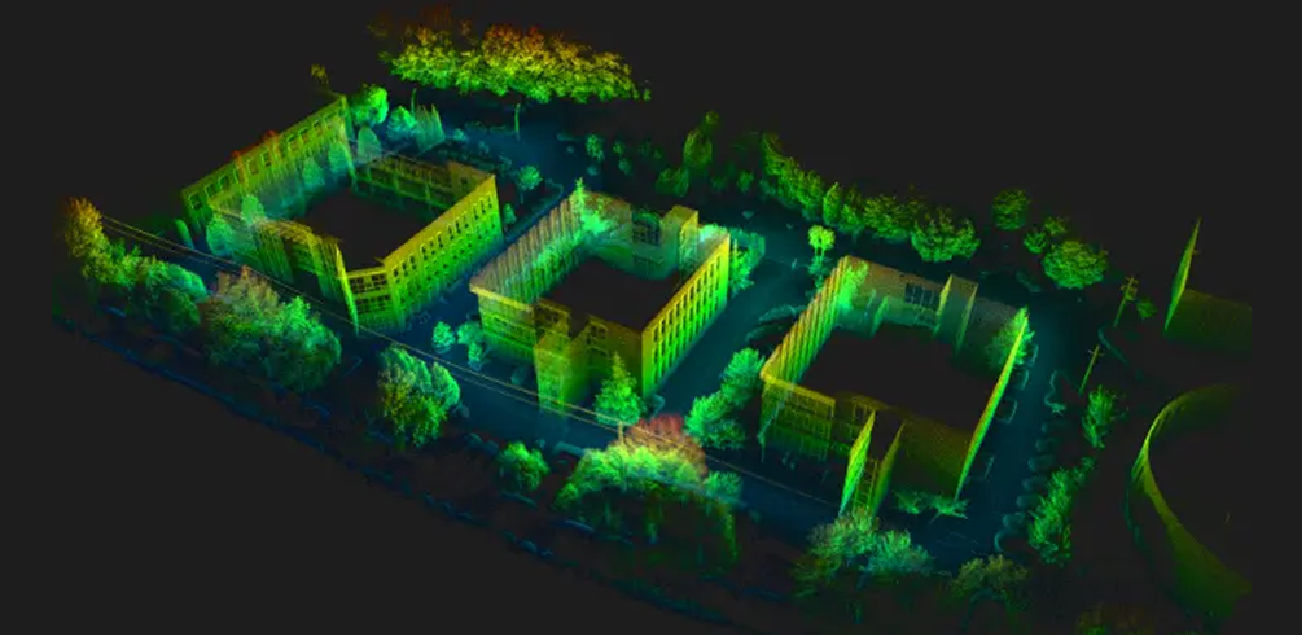
LiDAR — Light Detection and Ranging — is the sensor technology that gives autonomous robots the ability to perceive and navigate their environment with precision. If you've seen a robot moving smoothly through a busy warehouse, avoiding forklifts and people without human intervention, LiDAR is almost certainly doing the heavy lifting.
This article explains how LiDAR works, why it matters for industrial robotics, and what it means for facilities across Pakistan's manufacturing and logistics sectors.
LiDAR sensors emit rapid pulses of laser light and measure the time it takes for each pulse to reflect back from a surface. By firing thousands of these pulses per second in 360 degrees, a LiDAR sensor builds a continuous, real-time 3D point cloud of everything around the robot.
The result is a precise, distance-accurate map of the robot's immediate environment — updated dozens of times per second. The robot knows exactly where every wall, shelf, person, and obstacle is, even as they move.
Cameras capture colour and visual detail but struggle with depth perception, low lighting, and fast movement. LiDAR has no image, but its distance measurements are highly accurate regardless of lighting conditions. At 3am in a dark warehouse, a camera-only robot may struggle. A LiDAR-equipped robot navigates with the same precision it had at noon.
This distinction matters enormously for Pakistani industrial deployments. Security robots operating overnight, warehouse robots working across 24-hour shift cycles, inspection robots in poorly-lit storage areas — all require the lighting-independent reliability that LiDAR provides.
2D LiDAR scans a single horizontal plane around the robot. It's effective for mapping floor-level obstacles and navigating open warehouse floors where most obstacles are at a consistent height. It is lower cost and widely used in AMRs.
3D LiDAR scans multiple vertical layers simultaneously, building a full volumetric map. It detects overhanging objects, ramps, steps, and obstacles at varying heights. It is more expensive but provides significantly richer environmental data — used in outdoor robotics, inspection robots, and security platforms requiring full spatial awareness.
At Helpforce AI, sensor selection is driven by the specific requirements of each deployment. A warehouse floor robot doesn't always need 3D LiDAR. A security robot patrolling a multi-level facility may.
LiDAR data feeds directly into SLAM algorithms (Simultaneous Localisation and Mapping), which process the point cloud to build a map of the environment and calculate the robot's precise position within it. Together, LiDAR and SLAM give a robot everything it needs to navigate autonomously without GPS, without floor tape, and without external beacons.
This combination is what makes modern AMRs and security robots genuinely useful in the brownfield industrial facilities that dominate Pakistan's manufacturing landscape — buildings that were never designed for robotics but can now host them without physical modification.
Pakistani industrial facilities present specific challenges for robotic navigation: narrow aisles in godowns, inconsistent lighting in storage areas, high-traffic zones in FMCG distribution hubs, and dynamic floor conditions that change between shifts. LiDAR-based navigation handles all of these reliably.
In textile manufacturing in Faisalabad, LiDAR allows robots to navigate between machinery without fixed infrastructure. In pharmaceutical cold-chain warehouses in Lahore, LiDAR enables safe operation in low-light controlled environments. In large perimeter security deployments in Karachi's industrial zones, LiDAR provides reliable 360-degree environmental awareness for patrol robots operating through the night.
Every robot we deploy is equipped with sensor configurations validated in simulation before the hardware arrives at your facility. In NVIDIA Isaac Sim, we replicate your exact floor plan, model your lighting conditions, and test LiDAR performance against the specific obstacles and layout features of your building.
This means when the robot arrives, its navigation isn't being tested for the first time in your live facility. It's been tested thousands of times in a digital version of your facility. That's how we guarantee Day 1 performance.
Contact Helpforce AI to discuss what LiDAR-enabled autonomous robots would look like in your specific facility. We're Islamabad-based and deploy across Pakistan.