
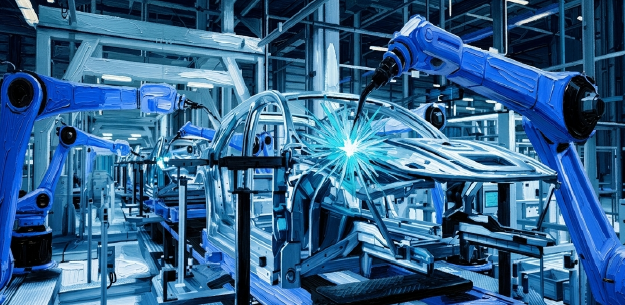
The term "Industry 4.0" has been circulating in Pakistani business circles for years — usually as an aspiration, rarely as an action plan. That's changing. And the catalyst isn't a government policy or a foreign investment round. It's the arrival of accessible simulation technology that allows any industrial operator to test before they invest.
Globally, automated storage and retrieval systems are gaining traction with adoption rates growing at over 10% annually. Asia Pacific now holds close to 40% of global warehouse robotics market share and is expanding rapidly. The warehouse robotics market, valued at USD 6.51 billion in 2025, is on track to exceed USD 25 billion by 2034.
Pakistan sits within this regional wave. The manufacturing sector contributes 12–13% of GDP, the country produces over 35,000 engineering and IT graduates annually, and private-sector robotics initiatives in Karachi and Lahore demonstrate real capacity. What has been missing is the methodology to deploy robotics at industrial scale — reliably, affordably, and without shutting down live operations to learn from expensive mistakes.
The traditional barrier to robotics adoption in emerging markets has always been simple: the cost of getting it wrong. Importing hardware, retrofitting facilities, and discovering mid-deployment that the system doesn't fit your SKU mix or aisle width — that's a financial catastrophe for most operators.
Simulation removes that risk entirely.
At Helpforce AI, we use NVIDIA Isaac Sim to build high-fidelity models of client facilities. We run thousands of simulated scenarios — rush-hour throughput, robot collision avoidance, power failure recovery, shift-change handoffs — before any physical hardware enters the picture. The result is a deployment that works on Day 1, not after months of painful iteration.
Industry 4.0 in a Pakistani context isn't about replicating Silicon Valley. It's about solving the real, immediate problems that Pakistani industrial operators face:
These aren't theoretical use cases. They're the conversations Helpforce AI is having with Pakistani operators right now.
Our deployment methodology works in three stages:
1. Simulate — We model your facility in NVIDIA Isaac Sim, validated against your actual floor plans, SKU data, and operational parameters. You see robot behaviour before we order hardware.
2. Deploy — Hardware arrives with simulation-verified configurations. Aisle widths, charging dock positions, patrol routes, and escalation protocols are all pre-tested. Downtime is minimal.
3. Scale — Once one facility is live and validated, replicating the deployment across your network is fast and low-risk. The simulation library becomes your playbook.
This approach is modelled on how global systems integrators like Accenture deploy NVIDIA-backed robotics blueprints at enterprise scale — adapted for Pakistani industrial reality.
Helpforce AI is a member of the NVIDIA Inception programme, giving us access to the latest Isaac Sim tools, Omniverse pipelines, and technical support from NVIDIA's global robotics team. We also hold active support from Microsoft for Startups and AWS Activate.
This means our clients in Pakistan are deploying systems built on the same technology stack used by the world's most advanced robotics programmes — but validated for their specific facilities, their specific workflows, and their specific commercial environment.
Pakistan's industrial automation surge is generating tangible economic momentum. Manufacturers using automation report output gains of up to 30% while cutting energy use by 20–25%. The companies that move first will set the benchmark that their competitors spend years trying to match.
Helpforce AI is Islamabad-headquartered, Pakistan-first in strategy, and expanding across Karachi, Lahore, Faisalabad, and Sialkot. If you want to understand what Industry 4.0 looks like for your facility — not in theory, but in simulation — the conversation starts here.