
If you've been researching autonomous robots for your facility in Pakistan, you've almost certainly come across the term SLAM. It appears in product sheets, robotics papers, and sales decks — usually without explanation. This guide breaks it down for engineers, operations managers, and industrial decision-makers who need to understand what SLAM actually is, why it matters, and what it means for robot deployment in Pakistani facilities.
SLAM stands for Simultaneous Localisation and Mapping. It refers to the computational process by which a robot builds a map of its environment while simultaneously keeping track of its own position within that map — all in real time, without any external reference like GPS.
Think of it this way: when you walk into an unfamiliar building, your brain automatically starts building a mental map — noting corridors, doors, and landmarks — while also tracking exactly where you are within that map. SLAM is the robotic equivalent of that process.
GPS works outdoors with line-of-sight to satellites. Inside a factory, a warehouse, or an industrial facility — which describes almost every deployment scenario in Pakistan — GPS signals are unavailable or unreliable. SLAM solves this by giving a robot the ability to navigate entirely from its own sensor data, with no reliance on external infrastructure.
This is why SLAM is foundational to every serious autonomous robot operating indoors: AMRs in warehouses, patrol robots in industrial facilities, inspection robots in manufacturing plants. Without SLAM, none of them work reliably.
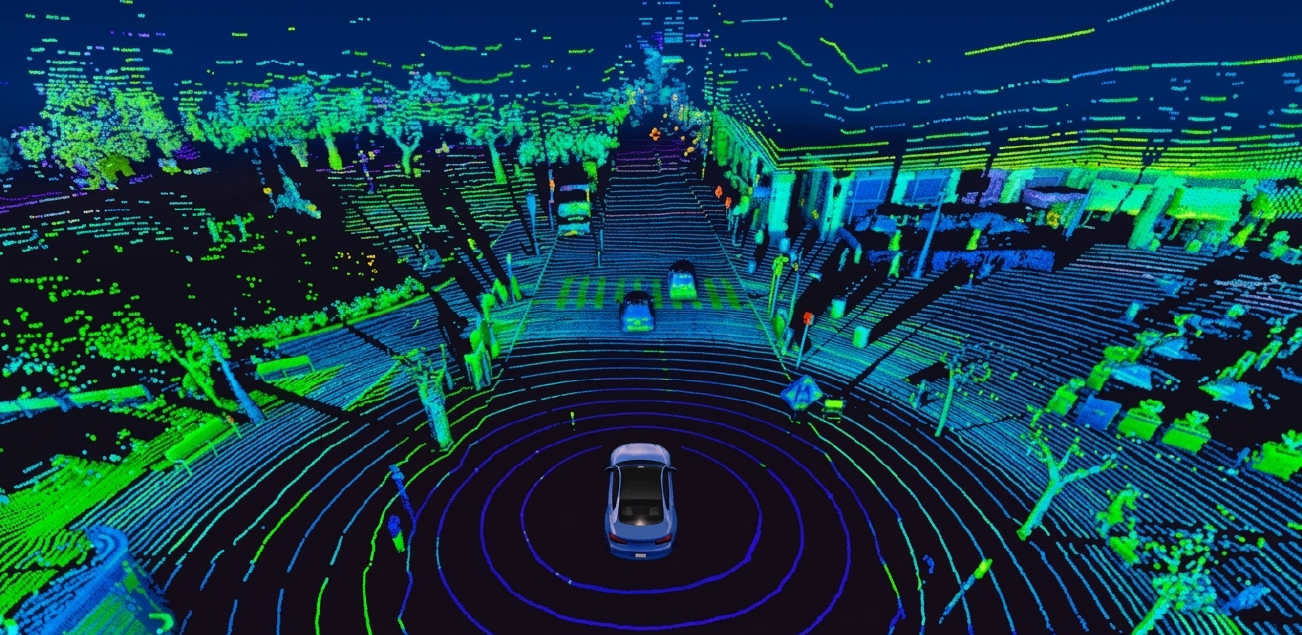
A SLAM-capable robot uses sensors — most commonly LiDAR (laser scanning), depth cameras, or a combination of both — to continuously scan its surroundings. As it moves, it builds a point-cloud map of the environment and uses that map to calculate its own position with high precision.
The core challenge SLAM solves is a chicken-and-egg problem: you need a map to localise yourself, but you need to know where you are to build an accurate map. Modern SLAM algorithms — including graph-based SLAM, particle filter SLAM, and visual SLAM — solve this by maintaining probability estimates and continuously refining both the map and the position estimate simultaneously.
LiDAR SLAM is the most widely used in industrial environments. LiDAR sensors emit laser pulses and measure their return time to create precise 2D or 3D maps. It is accurate, robust in low-light conditions, and well-suited to the warehousing and manufacturing environments common in Pakistan's industrial zones.
Visual SLAM (vSLAM) uses cameras instead of lasers. It is lower cost but more sensitive to lighting conditions. Suitable for environments with good consistent lighting and rich visual features.
Fusion SLAM combines LiDAR, cameras, and IMU (inertial measurement units) for maximum robustness. This is what Helpforce AI uses in security robotics deployments — where the robot must perform reliably across varying lighting conditions, day and night shifts, and complex multi-room facility layouts.
Most industrial facilities in Pakistan were not built with robotics in mind. Aisles change. Inventory moves. Forklifts create dynamic obstacles. SLAM allows robots to handle all of this dynamically — updating their maps in real time as the environment changes, rather than requiring a perfectly static floor plan.
This is critical in settings like Karachi's SITE industrial area, Lahore's Sundar Estate, or any FMCG distribution hub where floor conditions change constantly across shifts.
At Helpforce AI, we don't deploy a robot and hope its SLAM works in your facility. We build a high-fidelity 3D model of your facility in NVIDIA Isaac Sim first — and validate the robot's SLAM performance in simulation before any hardware ships. We test how the robot handles narrow aisles, dynamic obstacles, low-light zones, and shift-change scenarios, all virtually.
The result is a robot that arrives at your facility already trained, already mapped, and already proven. SLAM isn't a variable we leave to chance on Day 1.
If you want to understand what SLAM-capable autonomous robots would look like in your specific facility — warehouse, factory, or security — speak to the Helpforce AI team. We're based in Islamabad and deploy across Pakistan.