
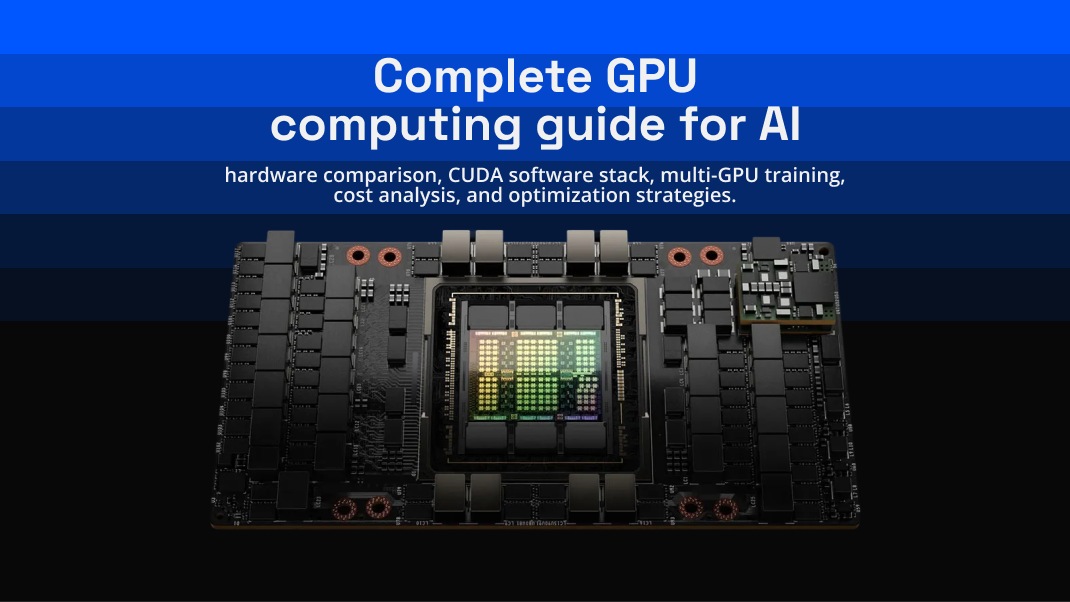
This comprehensive guide explains GPU technology, compares options, and provides optimization strategies for AI training workloads.
Graphics Processing Units (GPUs) have become the dominant hardware for AI training due to parallel processing architecture—thousands of cores processing simultaneously, whereas CPUs have 8-64 cores optimized for sequential processing. GPUs also offer high memory bandwidth, enabling fast data access (up to 3TB/s vs ~100GB/s CPU), specialized AI operations via tensor cores for matrix multiplication, and exceptional power efficiency measured by operations per watt.
A single modern GPU can outperform hundreds of CPU cores for AI training tasks—achieving 10-100x speedups at lower total cost.
Modern AI GPUs are purpose-built for machine learning:
CUDA Cores: General-purpose parallel processors handling floating-point operations, thousands per GPU (up to 18,432 in H100).
Tensor Cores: Specialized hardware for matrix multiplication (core AI operation), dramatically accelerating deep learning (up to 4x faster than CUDA cores), support mixed-precision training (FP16, BF16, INT8).
High-Bandwidth Memory (HBM): Stacked memory providing massive bandwidth (up to 3TB/s), essential for feeding hungry GPU compute, currently HBM3 in latest GPUs.
NVLink/Interconnects: High-speed GPU-to-GPU connections (900GB/s in H100), enabling efficient multi-GPU training, critical for large models exceeding single GPU memory.
Memory Capacity: 40-80GB in high-end AI GPUs (H100, A100), sufficient for large models and batches.
Specifications: 18,432 CUDA cores, 640 tensor cores (4th gen), 80GB HBM3 memory, 3TB/s memory bandwidth, 700W TDP, NVLink interconnect (900GB/s).
Performance: Up to 4 petaFLOPS FP8 (INT8) for AI training, 60 petaFLOPS FP8 inference, 1,000 TFLOPS mixed precision (FP16/BF16).
Pricing: $25,000-$40,000 per GPU.
Best For: Largest AI models, fastest training, production ML infrastructure, state-of-the-art research.
Specifications: 6,912 CUDA cores, 432 tensor cores (3rd gen), 40GB or 80GB HBM2e, 2TB/s memory bandwidth, 400W TDP.
Performance: 312 TFLOPS mixed precision (FP16/BF16), 19.5 TFLOPS FP64 (double precision).
Pricing: $10,000-$15,000 per GPU (40GB), $15,000-$20,000 (80GB).
Best For: Large model training, production inference, cost-effective alternative to H100, broad application support.
Specifications: 18,176 CUDA cores, 142 tensor cores (4th gen), 48GB GDDR6, 300W TDP, designed for inference + graphics.
Performance: 733 TFLOPS mixed precision (FP8), excellent for inference, good graphics rendering.
Pricing: $8,000-$12,000 per GPU.
Best For: Inference-heavy workloads, graphics + AI hybrid, cost-effective training for smaller models.
Specifications: 16,384 CUDA cores, 512 tensor cores (4th gen), 24GB GDDR6X, 450W TDP.
Performance: 165 TFLOPS mixed precision (FP16), impressive for consumer card.
Pricing: $1,600-$2,000.
Best For: Individual researchers, small projects, learning/experimentation, budget-constrained training.
Specifications: 304 compute units (19,456 stream processors), 192GB HBM3 (6 stacks), 5.3TB/s memory bandwidth, designed to compete with H100.
Pricing: Expected $15,000-$25,000.
Best For: Organizations seeking NVIDIA alternatives, PyTorch/ROCm workloads, massive memory needs (192GB).
Verdict: CPUs handle data preprocessing, orchestration, and serving, while GPUs perform actual training. Modern AI infrastructure uses both—CPUs feeding data to GPUs.
Training large models requires multiple GPUs working together:
Data Parallelism: Same model copied to each GPU, different data batches processed, gradients synchronized and averaged. Scales linearly up to 8-16 GPUs, easy to implement (PyTorch DataParallel).
Model Parallelism: Model split across GPUs (different layers on different GPUs), necessary when model exceeds single GPU memory, more complex implementation.
Pipeline Parallelism: Model split into stages, micro-batches processed through pipeline, improves efficiency of model parallelism.
Tensor Parallelism: Individual layers split across GPUs, highest communication requirements, needed for absolutely massive models.
Large language model training uses combinations—typically data + tensor parallelism.
NVIDIA's CUDA platform enables GPU computing:
CUDA: Parallel computing platform and API, enables C/C++/Python GPU programming, industry standard for GPU computing.
cuDNN: Deep learning primitives library, optimized implementations of common operations, used by PyTorch, TensorFlow.
cuBLAS: Linear algebra on GPU, fast matrix operations, foundation of AI computations.
TensorRT: Inference optimization, model compression and acceleration, deployment to production.
NCCL: Multi-GPU communication library, efficient gradient synchronization, essential for distributed training.
ML Frameworks: PyTorch and TensorFlow abstract CUDA, developers write high-level Python, frameworks handle GPU optimization.
Providers: AWS (P5 instances with H100s), Azure (ND series), Google Cloud (A3 instances), Lambda Labs, CoreWeave.
Pricing: $2-$10 per GPU-hour depending on model, H100s: ~$5-8/hour, A100s: ~$2-5/hour.
Advantages: No upfront capital, infinite scalability, pay only for usage, latest hardware without purchasing, geographic distribution.
Disadvantages: Costs accumulate quickly, data transfer charges, less control over infrastructure, potential availability constraints.
Investment: $50,000-$100,000+ per GPU server (4-8 GPUs), plus networking, storage, cooling infrastructure.
Advantages: Lower long-term costs at scale, complete control and customization, no data transfer costs, consistent availability.
Disadvantages: Large upfront investment, hardware becomes obsolete, maintenance and management overhead, limited scalability (physical constraints).
Decision Factors: Training frequency (continuous → on-prem, occasional → cloud), model size (huge → cloud burst capacity), budget model (CapEx vs OpEx), data sensitivity (highly sensitive → on-prem).
Many organizations use hybrid—on-prem for regular training, cloud for burst capacity.
Mixed Precision Training: Use FP16 instead of FP32 (2x memory, ~2x speed), maintain FP32 master weights, automatic mixed precision in PyTorch/TensorFlow.
Gradient Checkpointing: Trade computation for memory, recompute activations during backward pass, enables larger models/batches.
Gradient Accumulation: Simulate large batches on limited memory, accumulate gradients over multiple small batches, single update step.
Model Compilation: PyTorch 2.0 compile(), TensorFlow XLA, optimizes computation graphs, 20-50% speedup typical.
Data Pipeline Optimization: Prefetch data to GPU, parallelize data loading, optimize data augmentation, avoid bottlenecks.
Efficient Architectures: Transformer variants (Flash Attention), pruning (removing unimportant connections), knowledge distillation (smaller model learning from larger).
These techniques often yield 2-5x efficiency improvements—equivalent to adding GPUs but at zero cost.
Modern AI GPUs consume enormous power:
Power Requirements: H100: 700W per GPU (×8 = 5,600W per server), A100: 400W per GPU (×8 = 3,200W per server), plus CPU, memory, networking overhead. Total: 6-8kW per server typical.
Cooling: Air cooling struggles with high densities, liquid cooling increasingly necessary, direct-to-chip liquid cooling, immersion cooling for densest deployments.
Data Center Impact: AI racks consume 10-20x normal servers, electrical infrastructure limiting factor, specialized AI data centers emerging.
Cost: $0.10-$0.30 per kWh, H100 server at 8kW: ~$500-$1,200 monthly electricity (24/7 operation).
Power becomes significant OpEx—optimization reducing power consumption directly reduces costs.
Costs: 8× H100 server: $280,000, networking/storage: $50,000, installation/setup: $20,000, Total: $350,000. Annual power: $8,000, maintenance: $15,000, staff: $50,000 (partial allocation), Annual OpEx: $73,000. 3-Year TCO: $569,000.
Cloud Alternative: 8× H100 at $40/GPU-hour = $320/hour. 50% utilization (12 hours/day): $3,840/day = $115,200/month = $1.38M/year. 3-Year Cost: $4.15M.
Breakeven: ~4 months of full-time use.
Conclusion: High utilization strongly favors on-premises, occasional use favors cloud.
Larger Memory: H200 (141GB HBM3e), moving toward TB-scale GPU memory.
Specialized AI Chips: Google TPUs, AWS Trainium/Inferentia, emerging custom accelerators.
Efficiency Improvements: Better performance-per-watt, specialized low-precision formats (FP4, FP6).
Optical Interconnects: Faster GPU-GPU communication, reducing multi-GPU bottlenecks.
Integration: GPU+CPU hybrid chips, tighter integration reducing latency.
Software: Better compiler optimizations, automated performance tuning, higher-level abstractions.
For UAE and Saudi Arabia:
Sovereign AI Capability: Building domestic AI training infrastructure, reducing dependence on foreign clouds, data sovereignty and security.
Research Excellence: Universities and research centers need GPU access, compete globally in AI research.
Startup Ecosystem: AI startups need affordable GPU access, cloud credits or shared facilities.
Energy Advantage: Abundant solar potential, powering energy-intensive AI infrastructure sustainably.
Strategic Positioning: Regional AI hub serving Middle East/Africa, attractive to international AI companies.
For Individuals/Students: Start with Google Colab (free GPU access), upgrade to RTX 4090 if serious ($1,600 investment), use Kaggle notebooks (free).
For Startups: Begin with cloud (AWS, Lambda, CoreWeave), scale usage gradually, consider on-prem when training becomes continuous.
For Enterprises: Hybrid approach—on-prem for regular training, cloud for burst capacity. Plan 3-5 year infrastructure, budget for continuous upgrades.
For Research Institutions: Shared GPU clusters, fair scheduling systems, balance between department purchases and centralized resources.
GPU computing has become the foundation of modern AI, transforming what's possible in machine learning. Understanding GPU technology—architectures, options, optimization, economics—is essential for anyone serious about AI development.
Whether you're training language models, computer vision systems, or robotics applications, GPUs provide the computational power making it feasible. The right GPU strategy—hardware selection, cloud vs on-prem, optimization techniques—dramatically impacts both capability and cost.
As AI advances, GPU technology evolves in lockstep. Organizations and individuals who master GPU computing gain significant advantages in the AI revolution transforming industries globally. For the Middle East specifically, building GPU infrastructure and expertise is strategic—enabling sovereign AI capabilities and regional technology leadership.
The future is GPU-accelerated. The question is whether you'll harness this power effectively to drive your AI ambitions forward.