
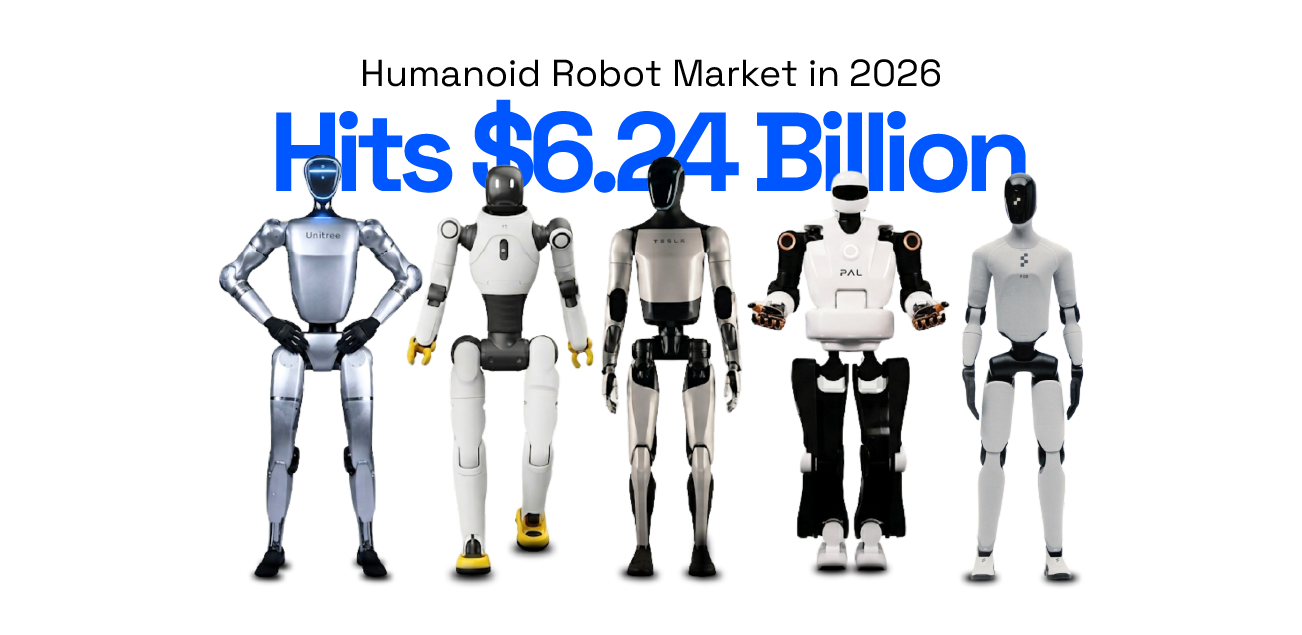
The global humanoid robot market has reached $6.24 billion in 2026 and is projected to hit $165 billion by 2034, growing at a CAGR of 50.6%. A separate MarketsandMarkets analysis pegs the market at $2.92 billion in 2025 reaching $15.26 billion by 2030 at 39.2% CAGR. The range across analysts is wide but the direction is unanimous: this market is growing faster than nearly any other segment in industrial technology.
For industrial operators, the question is not whether this market matures. It is whether your operation leads the transition or reacts to it.
Three structural forces are converging. Labor shortages are permanent — 69% of manufacturers globally are investing in robots specifically to fill workforce gaps, not cut existing staff. Wage costs are outrunning inflation by a factor of four in most developed markets. And the cost of inaction is compounding: unscheduled downtime costs the world's 500 largest companies $1.4 trillion per year.
Humanoid robots are no longer confined to research labs. Tesla is targeting 100,000 Optimus units by end of 2026. BYD aims for 20,000 units. Agility Robotics has built a dedicated facility capable of 10,000 Digit robots annually. These are not concept targets — they are production commitments backed by infrastructure investment.
The hardware segment currently dominates — 69.5% market share in 2026 — driven by actuator complexity, battery density, and precision control systems. But software is gaining: AI, natural language processing, and computer vision are increasingly determining which robots actually work at scale and which remain impressive demos.
The biped segment holds the highest market share at 70.5% in 2026, driven by applications in manufacturing, healthcare, and logistics where human-like mobility is required to navigate environments built for people.
Pakistan's industrial operators are scaling into a market where the automation infrastructure is being built globally. The operators who move now do not just gain efficiency — they gain the data advantage. A facility that has been running robots for two years has two years of operational data for refinement that a 2028 adopter starts from zero. At Helpforce AI, we deploy simulation-first robotics for Pakistan's warehouses and security operations. The window for first movers is open. Not indefinitely.