
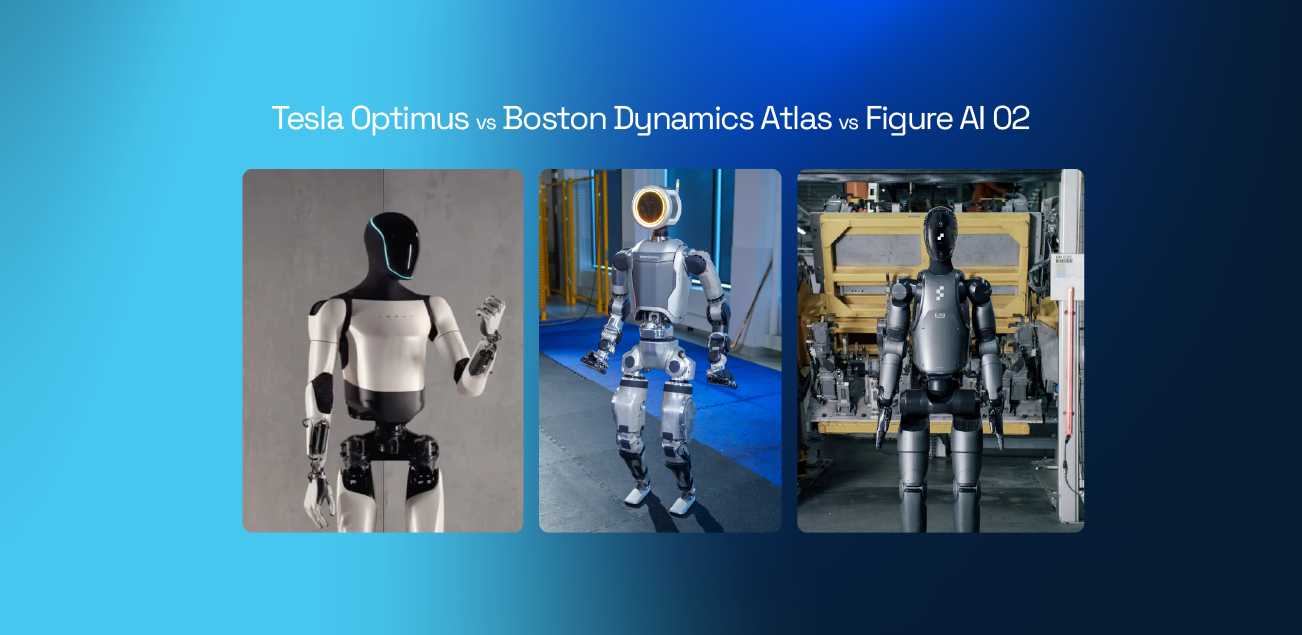
The humanoid robot space has three names that dominate every conversation: Tesla Optimus, Boston Dynamics Atlas, and Figure AI 02. Every week brings new demos, new claims, and new investment rounds. But for an industrial operator evaluating where to deploy automation budget, there is only one question worth asking: which of these is actually operational in an industrial environment right now?
Tesla's Optimus is currently the most discussed and the most ambitious. Gen 2 robots are performing real production tasks inside Tesla's Fremont and Austin factories — battery cell sorting, parts handling, quality inspection. Gen 3 was walking internally as of March 2026 with public reveal delayed for finishing touches. Mass production targeting 1 million units annually from Fremont, with volume ramp in 2027.
Operational status: Internally deployed at Tesla factories. Not available to external operators yet. Expected external sales to enterprise customers late 2026 at $25,000 to $40,000.
Boston Dynamics retired the hydraulic Atlas in April 2024 and unveiled the fully electric version. The electric Atlas is designed for industrial use from the ground up — stronger, faster, and built for real factory environments rather than research demonstrations. Hyundai and Boston Dynamics are targeting automotive manufacturing use cases first. Atlas is already working in Hyundai facilities in limited deployment.
Operational status: Limited industrial deployment in automotive. Not generally available. Commercial timeline not publicly confirmed.
Figure AI secured $675 million in funding from NVIDIA, Microsoft, Jeff Bezos, and OpenAI. Figure 02 is deployed at BMW's Spartanburg factory performing real manufacturing tasks. The robot uses a multimodal AI system trained through imitation learning and reinforcement learning, with a heavy emphasis on simulation-first training methodology.
Operational status: Live deployment at BMW. Commercial partnerships active. Not available to operators outside direct enterprise agreements.
None of these three are available for a distribution center in Lahore or a manufacturing facility in Karachi today. What is available is the methodology that all three depend on: simulation-first deployment. Build a digital twin of the facility. Train the robot there. Deploy hardware that already knows the environment.
At Helpforce AI, we apply that same methodology for Pakistan's warehouses and security operations — using NVIDIA Isaac Sim, the same infrastructure Figure AI and BMW rely on. You do not need to wait for Optimus to reach Karachi. The capability is here now.